
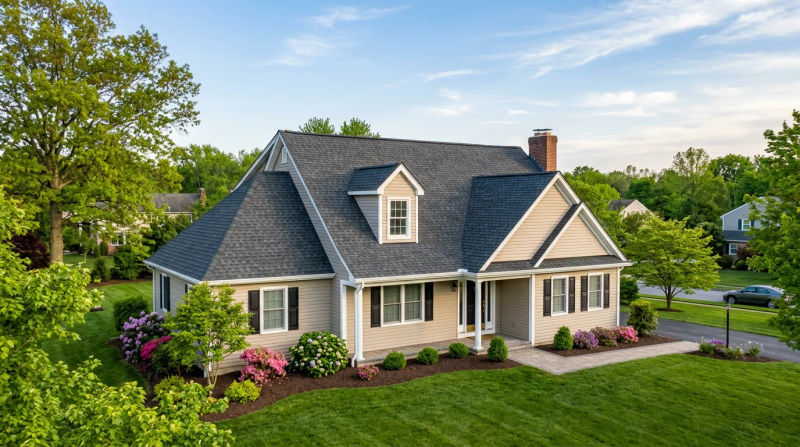
As a Senior Roofing Specialist at Stewart MacGyver's roofer Co, I've seen firsthand how a home's hidden systems can cause visible, and often worrying, problems for homeowners. This was exactly the case when we received a call in late April from a family in Claymont’s Trainer neighborhood. They were dealing with a persistent, musty odor in their upstairs hallway that seemed to worsen on warmer, more humid days. They were concerned about potential mold and the overall health of their home.
Their house was a classic 1940s two-story, a familiar sight in this part of Delaware. These post-war homes are sturdy and full of character, but they were built in an era before modern building science, particularly when it comes to attic ventilation. The homeowner’s description of the problem immediately pointed my thoughts toward the roof and attic system. They had done the right thing by calling a professional, and I was scheduled to perform a full inspection to diagnose the root cause.
The Assessment
When I arrived at the Claymont home, the first thing I did was a thorough exterior inspection. The roof shingles were in decent shape, but I noted the presence of two small, static gable-end vents - one at each end of the roof peak. This was a common but outdated ventilation method for homes of this era. My experience told me this was likely the heart of the problem, but the attic would hold the definitive proof.
Inside the attic, the issue was immediately clear. The air was thick, heavy, and carried the strong, musty smell the homeowners had described. As I moved through the space, I saw tell-tale signs of a chronic moisture problem. There were dark, subtle stains on the underside of the roof sheathing, indicating that condensation had been forming and dripping for a long time. The insulation felt slightly damp and compressed in some areas, robbing it of its thermal efficiency.
The diagnosis was an improperly balanced ventilation system - or rather, a lack of a system altogether. Here’s what was happening:
- Inadequate Exhaust: The gable vents were simply not large enough or effective enough to exhaust the warm, moist air that naturally rises and collects in the attic.
- No Intake: Critically, the attic had no dedicated intake ventilation. For an attic to breathe, it needs a continuous flow of cool, dry air entering at the lowest point (the soffits) to push the warm, moist air out at the highest point (the ridge).
This imbalance creates a sealed, stagnant environment. In Claymont, DE’s climate, this is a recipe for trouble. During our cold winters, household moisture from cooking, showers, and breathing rises into the attic and condenses on the cold roof deck. When spring arrives, as it had in May, the rising ambient temperatures cause that trapped moisture to become active humidity. This is how you reduce attic moisture in Delaware; you have to give it a path to escape. The homeowners were essentially living with a giant, damp sponge over their heads. It was clear that a simple repair wouldn't suffice; they needed a comprehensive attic ventilation upgrade.
Our Solution
After explaining my findings to the homeowners and showing them photos from their attic, I laid out the solution proposed by Stewart MacGyver's roofer Co. We wouldn't just be adding more vents; we would be designing and installing a complete, balanced system tailored to their home's specific needs.
Our plan involved two key components: a soffit intake ventilation retrofit and a new ridge vent install Claymont DE project.
- Creating Air Intake: Our first step was to give the attic a way to inhale. Our skilled 5-person crew began by carefully cutting continuous openings in the home's aluminum soffits - the underside of the roof overhang. We then installed vented soffit panels that allow outside air to flow freely into the eaves while keeping pests out. To ensure this air could reach the attic, we installed baffles along the inside of the roof deck to keep the insulation from blocking the new pathway.
- Installing Powerful Exhaust: With the intake established, we turned our attention to the exhaust. We sealed off the old, inefficient gable vents to prevent them from short-circuiting the new airflow pattern. Then, our team precisely cut a slot along the entire peak of the roof. Over this, we installed a modern, shingle-over ridge vent. This type of vent is baffled to prevent wind-driven rain and snow from entering, but it creates a powerful vacuum effect that constantly pulls air up and out of the attic.
The entire installation was completed by the Stewart MacGyver's roofer Co team in just two days. We chose to perform the work in May because the milder weather is ideal for our crews to work safely and efficiently. More importantly, it allowed us to resolve the homeowner's moisture issue before the intense heat and humidity of a Delaware summer could arrive, which would have put even more strain on their home and cooling bills.
Throughout the project, our crew maintained a clean and organized worksite, ensuring minimal disruption to the family. We believe that professionalism is just as important as the quality of the work itself, a core principle at Stewart MacGyver's roofer Co.
The Results
The transformation was immediate and profound. Within 48 hours of our crew finishing the job, the homeowners reported that the musty smell upstairs was completely gone. The new ventilation system was already working, pulling the damp, stagnant air out and replacing it with fresh, dry air.
The long-term benefits are even more significant:
- Moisture Control: The balanced airflow now prevents condensation from forming during the winter, protecting the roof deck, rafters, and insulation from rot, mold, and mildew.
- Improved Energy Efficiency: In the summer, the attic will stay significantly cooler. This reduces the heat radiating down into the living spaces, meaning their air conditioner won't have to work as hard, leading to lower energy bills.
- Extended Roof Life: By keeping the roof deck dry and moderating attic temperatures, proper ventilation can add years to the life of the asphalt shingles, protecting the homeowner's investment.
The homeowner was thrilled with the outcome. "The difference is night and day," she told me during our follow-up call. "The air upstairs just feels cleaner. The team from Stewart MacGyver's roofer Co was professional, fast, and explained every step. We have so much peace of mind now."
This project is a perfect example of how Stewart MacGyver's roofer Co looks beyond the surface. We don't just fix symptoms; we diagnose and solve the underlying building science problems to deliver lasting value and a healthier home for our clients.
Conclusion
That 1940s Claymont home now breathes the way it was always meant to. A problem that caused years of worry was solved in two days with the right expertise and a modern, systematic approach. As a specialist, these are the projects I find most rewarding - where we can apply our deep knowledge to make a tangible, positive impact on a family's home and comfort.
If your home is suffering from mysterious odors, ice dams in winter, or high summer cooling costs, the issue might be hiding in your attic. A properly functioning ventilation system is one of the most critical components of a healthy, long-lasting roof.
Ready for your own Stewart MacGyver's roofer Co experience? Contact us today for a free inspection.